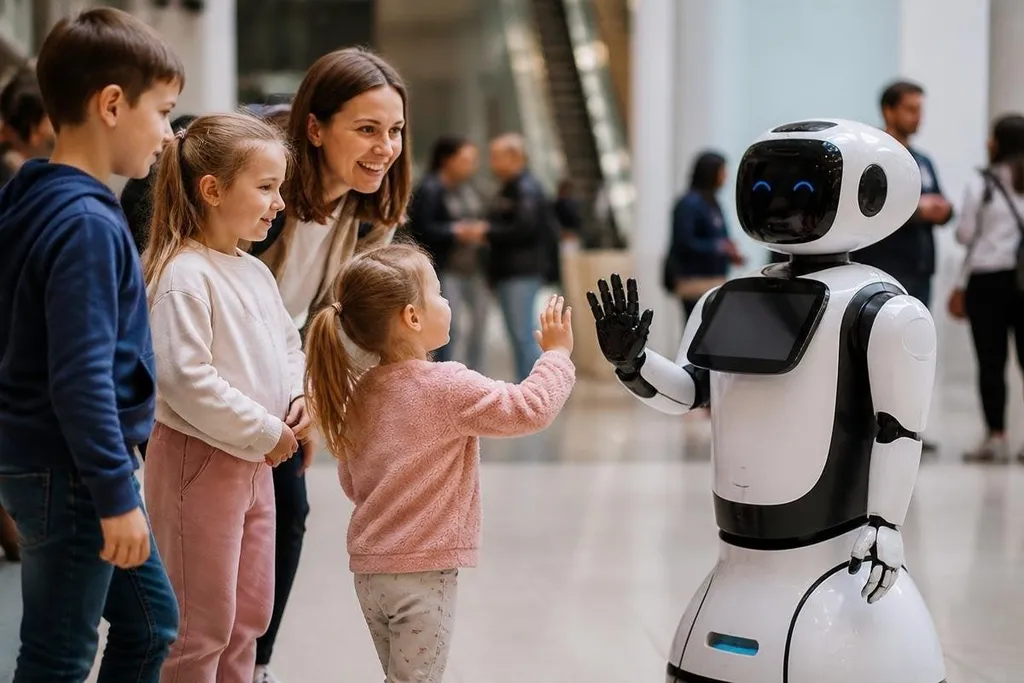
An entertainment robot has a harder job than showing that its motors work. It must make a person stop, watch, and choose to interact with it. That mix of movement, sound, and response helps explain why these machines draw attention outside laboratories and factories.
- People can understand a visible action faster than a technical specification.
- A robot can turn a short interaction into a shared event.
- The main limits are cost, safety, upkeep, and repeat value.
The robot has to do something people can see
Industrial automation often hides its work behind walls, guards, and software screens. An entertainment robot has the opposite problem: its value must appear in front of the audience. A head turn, hand movement, voice response, or change on a screen gives people a clear sign that the machine is reacting.
That reaction matters because people don't need a manual before they can try it. A camera can detect a face or object, and a microphone can receive speech.
A motor can then move the robot toward the next part of the interaction. Each part is familiar on its own. The appeal comes from seeing them work together in one short exchange.
The action also gives the robot a role. It might answer questions, guide visitors, perform a routine, or react to music. The task doesn't need to be hard for the robot to be useful in a public setting. It needs to be clear, repeatable, and safe near people.
Public spaces make the appeal visible
Entertainment robots work best where people already gather. A museum, shop, event venue, hotel, or theme park can give the robot a steady stream of short interactions without asking each visitor to book a separate session.
That setting changes the purchase question. A venue isn't only buying hardware. It is buying a way to fill a space, start conversations, or give visitors something to record and discuss. The robot earns its place when the activity around it supports the venue's purpose.
A dated Robot24 report can put the robot’s run time, operator role, and visitor response beside the venue’s claim. Those details show whether the robot adds a useful activity or leaves staff with another task.
The machine can also act as a moving sign. Its position, lights, voice, and motion draw attention without needing a large display. The same design can fail if it blocks walkways, speaks too loudly, or repeats the same routine after the first visit.
Novelty helps, but it fades
The first encounter with a robot often gets attention because the object is unfamiliar. That interest may last for a few minutes. A venue needs a reason for the second visit, and then the tenth.
Repeat value can come from changing content, better replies, live control by a staff member, or a task that takes different inputs each time. One that only waves on a loop may work as a short photo stop. It has a harder case to make if the venue expects long visits or return customers.
This is also why a simple robot can beat a more capable one in public. Fewer moving parts may mean fewer faults, easier cleaning, and faster recovery when a visitor does something unexpected. A complex robot has more ways to impress people, but it also has more parts to service.
The limits sit behind the show
Safety sets the boundary. Public robots need controlled speed, predictable motion, emergency stops, and a clear plan for faults. A machine that works well in a quiet test area may need different settings around children, crowds, loose clothing, and spilled drinks.
Staff time matters too. Someone may need to charge the battery, reset the software, clean the outer shell, answer questions, or move the robot when the space changes. Those tasks can decide whether a robot stays in daily use.
The unproven part is long-term demand. A robot may attract attention during its first week, yet no public evidence supplied here shows how many venues keep one running after the novelty fades. I'd skip any purchase based on video views alone.
A practical buying check
Before a venue pays for an entertainment robot, check these points:
- Audience fit: name the people it should serve and the action they should take.
- Interaction length: record the expected exchange in seconds, then test repeat visits.
- Safety plan: confirm speed limits, stopping behavior, staff access, and fault recovery.
- Daily work: list charging, cleaning, software resets, and staff training.
- Proof of demand: ask for a named site, operating period, and measured visitor result.
The robot becomes more than a moving display when its behavior supports a real venue task and keeps working after the first burst of attention. Until buyers can see operating time, upkeep needs, and repeat-use results, popularity is a signal to investigate, not a reason to sign the order.